
Blinds collect dust quickly, but cleaning them safely starts with one simple decision: identify the material before adding moisture. For most blinds, the safest routine is to remove loose dust with a soft cloth or a vacuum brush attachment, then use only the material-specific care method recommended by the manufacturer. That approach clears everyday buildup without warping slats, staining fabric, or dulling a finish.
This guide shows how to clean blinds in place, what to avoid, and when a delicate or heavily soiled window treatment is better left to a specialist.
Table of Contents
- How do you identify the blind material?
- What supplies do you need?
- Why should you dry-clean blinds first?
- How do you clean real wood blinds?
- How do you clean faux-wood and metal blinds?
- How do you clean fabric shades?
- What mistakes can damage blinds?
- What if dust or spots remain?
- When should you call a professional?
- Cleaning blinds FAQ
How do you identify the blind material?
Look at the slats, vanes, or pleats before you begin. Real wood usually shows natural grain variation and feels lighter than composite material. Faux wood often has a uniform printed grain and may be made from PVC or a composite. Metal blinds have thin, flexible slats. Cellular, roller, Roman, and sheer shades are fabric-based window treatments, even when they are casually called blinds.
If you are unsure, check the label inside the headrail, the installation paperwork, or the manufacturer’s website. Motorized products and blinds with decorative tapes can have extra restrictions. The safest rule is to treat an unknown material as delicate: start dry, apply no cleaner, and test any approved method in a hidden area.

What supplies do you need?
A short supply list is usually enough:
- Two or more clean microfiber cloths
- A vacuum with a soft brush attachment
- A stable step stool if the headrail is above comfortable reach
- A bowl of lukewarm water only when the product instructions allow damp cleaning
- A mild product approved by the blind manufacturer, if needed
- A towel for protecting the sill or floor during approved damp cleaning
Skip abrasive pads, stiff brushes, chemical solvents, and strong all-purpose sprays unless the product’s instructions specifically permit them. Do not mix cleaners. More product does not mean better results, and residue can make slats look streaky or attract dust faster.
Why should you dry-clean blinds first?
Dry dusting removes loose particles before they can become muddy streaks. It also gives you a chance to notice loose cords, cracked slats, delicate tapes, or a finish that should not get wet.
Use this basic process:
- Lower the blind fully. Keep it supported and avoid pulling hard on the lift cord or wand.
- Tilt the slats almost closed. Leave a slight gap so the overlapping edges remain accessible.
- Dust from the top down. Wipe gently with a clean microfiber cloth or use the vacuum’s soft brush attachment at low suction.
- Reverse the tilt. Clean the other side with the same light pressure.
- Vacuum the sill and floor. Removing fallen dust now prevents it from circulating back onto the window treatment.
Hunter Douglas recommends routine dusting and gentle vacuuming with a brush attachment for many window treatments, while noting product-specific exceptions for delicate fabrics. Its current care guidance also suggests cool air for selected products—not warm or hot air, which can distort delicate materials. Review the instructions for your exact product before using air or suction. See Hunter Douglas care guidance.
How do you clean real wood blinds?
Real wood blinds need a dry-first approach because excessive moisture can affect the wood and its finish. Support each slat with one hand and wipe with a dry, soft cloth using light pressure. Work from the center toward the ends so you do not pull against the ladder cords.
For settled dust, use a vacuum brush attachment gently. Avoid soaking, steam, chemical solvents, and scrubbing cleansers. Hunter Douglas specifically advises protecting fine wood products from high moisture and spraying glass cleaner onto a cloth—not directly at the window—so overspray does not reach the finish. Review the manufacturer’s wood-blind guidance.
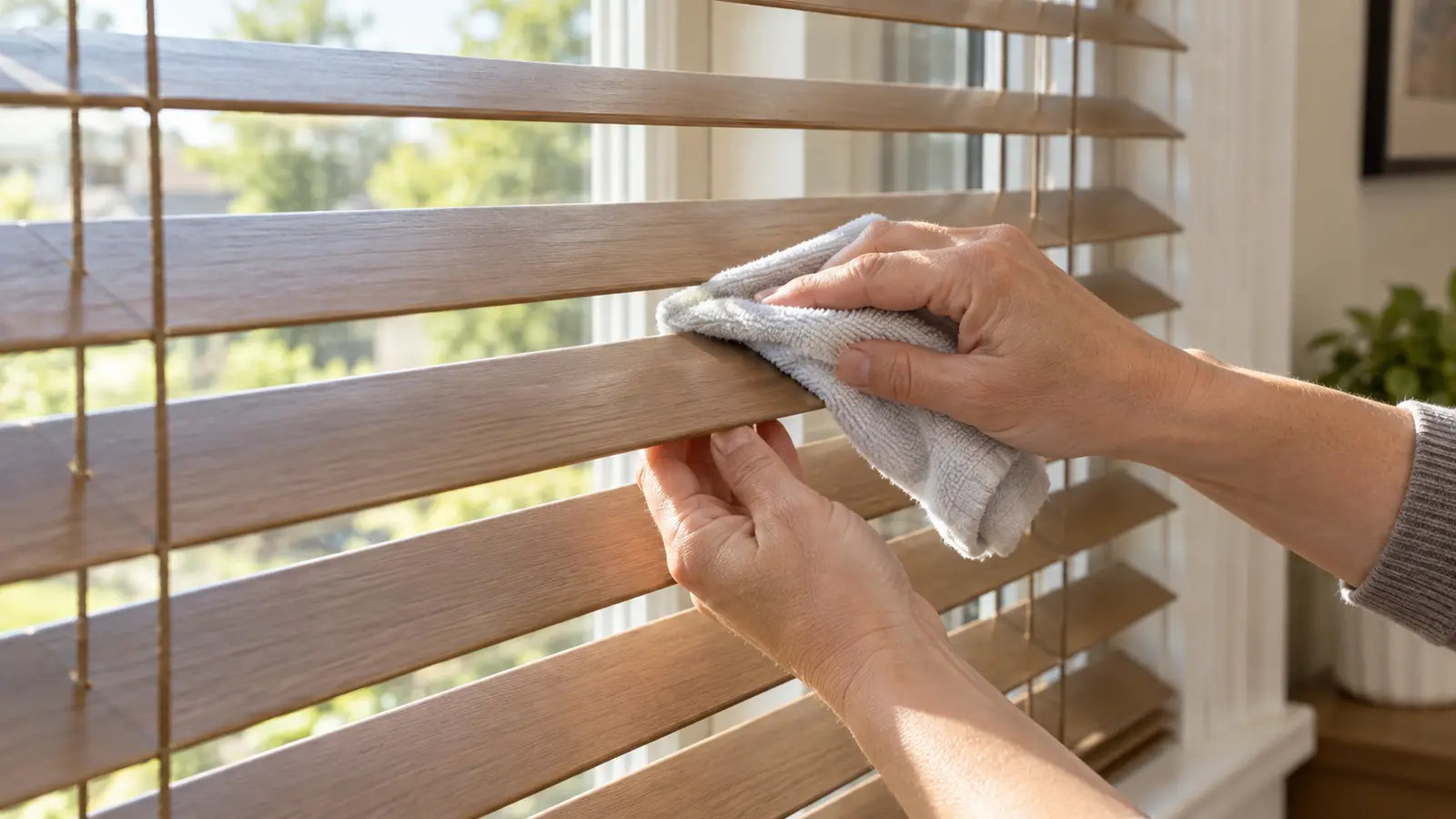
If a real-wood slat has a mark that dry dusting will not remove, stop before experimenting. Check the model’s care guide or contact the manufacturer. A spot can be less noticeable than a permanently dulled or swollen finish.
How do you clean faux-wood and metal blinds?
Faux-wood and metal blinds are often more tolerant of a lightly damp cloth, but that does not make every blind washable. Motorized headrails, decorative tapes, coatings, and specialty collections may require different care.
- Remove loose dust on both sides.
- Read the product label or care guide.
- If damp cleaning is approved, wring the microfiber cloth until it is only lightly damp.
- Support one slat at a time and wipe without bending it.
- Follow immediately with a clean dry cloth.
- Leave the blind lowered until every surface is dry.
LEVOLOR’s current guidance allows a soft, lightly dampened cloth for faux-wood and metal blinds and warns against solvents or abrasive solutions. Check LEVOLOR’s material-specific instructions. Do not assume that bathtub immersion is safe: even where a manufacturer permits it for a particular metal collection, headrails, decorative tapes, lift systems, or other components may be excluded.
How do you clean fabric shades?
Fabric shades need the lightest touch. Begin with gentle dusting, low-suction vacuuming with an approved attachment, or cool air if the manufacturer allows it. Move vertically on pleated or sheer products to avoid pulling the structure sideways.
Do not automatically spot-clean fabric. Some materials can be blotted with lukewarm water and a mild approved detergent, while others can crease, discolor, or develop a visibly cleaner patch. Hunter Douglas lists products and fabrics that should not be spot-cleaned, and LEVOLOR warns that window-cleaning products can discolor certain shades. Product-specific instructions should decide the method.
If spot cleaning is approved, test an inconspicuous area first. Use a clean white cloth, blot instead of rubbing, keep moisture away from motors and headrails, and allow the shade to dry fully in the position recommended by the manufacturer.
What mistakes can damage blinds?
- Spraying the window directly. Cleaner can splatter onto wood, fabric, cords, and headrails. Apply glass cleaner to a cloth away from the treatment.
- Starting wet. Water turns loose dust into streaks and can push grime into fabric or cord openings.
- Using one method on every material. A damp cloth that works on approved faux wood may damage real wood or leave a mark on fabric.
- Scrubbing thin slats. Excess pressure can bend metal or crack an aging finish.
- Using heat. Hot air and steam can distort some synthetic or delicate products unless explicitly approved.
- Soaking the headrail. Water can reach mechanisms or electronics.
- Closing slats completely while dusting. Overlapping edges remain dirty. Tilt them almost closed instead.
What if dust or spots remain?
If dust returns immediately, clean the sill, frame, nearby vent, and floor before repeating the blind. Replace or wash the microfiber cloth once it stops picking up particles. Working with a dirty cloth simply redistributes dust.
For greasy buildup near a kitchen, first confirm the blind material and approved cleaner. Do not improvise with degreasers, solvents, or abrasive powders. Use the smallest amount of an allowed product on a hidden area, then dry promptly. If residue remains, contact the manufacturer or a specialist.
For streaks on approved faux-wood or metal blinds, repeat with a clean, barely damp cloth and immediately buff dry. For spots on fabric or real wood, pause instead of adding more moisture.
When should you call a professional?
Professional help may be appropriate for tall or difficult-to-reach windows, delicate sheers, motorized treatments, smoke or heavy grease residue, mold-like growth, damaged cords, or a treatment whose instructions require a specialized process. Some manufacturers recognize professional injection/extraction or ultrasonic cleaning only for selected products; those methods are not universal.
If the blinds are part of a larger reset, SRS can help with the surrounding room, window sills, baseboards, floors, and other included surfaces. Explore house cleaning services, review the baseboard-cleaning guide, or use the whole-house cleaning checklist to plan the work in a practical order.
Cleaning blinds FAQ
What is the fastest safe way to clean dusty blinds?
Lower them, tilt the slats almost closed, and work from top to bottom with a clean microfiber cloth or an approved soft vacuum brush. Reverse the tilt and clean the other side. This dry-first method is appropriate for many products, but always check the care guide.
Can you clean blinds with water?
Only when the manufacturer permits it for that material and model. A lightly damp cloth may be suitable for some faux-wood or metal blinds. Real wood, fabrics, motors, headrails, and decorative tapes can have stricter limits.
Should you remove blinds before cleaning?
Routine dusting is usually done in place. Removal or immersion should happen only when the product instructions explicitly approve it and you can safely handle and reinstall the treatment.
How often should blinds be dusted?
There is no universal schedule. Dust them when buildup becomes visible or during the room’s regular cleaning cycle. Homes near open windows, busy roads, pets, or active ventilation may need more frequent attention.
Want the rest of the room to feel just as refreshed?
SRS Cleaning Services provides dependable house cleaning across Orange County. Tell us what needs attention and request a quote without pressure.